
Europe’s ocean energy pipeline reaches 200 devices and 200 MW as public funding leverages private investment
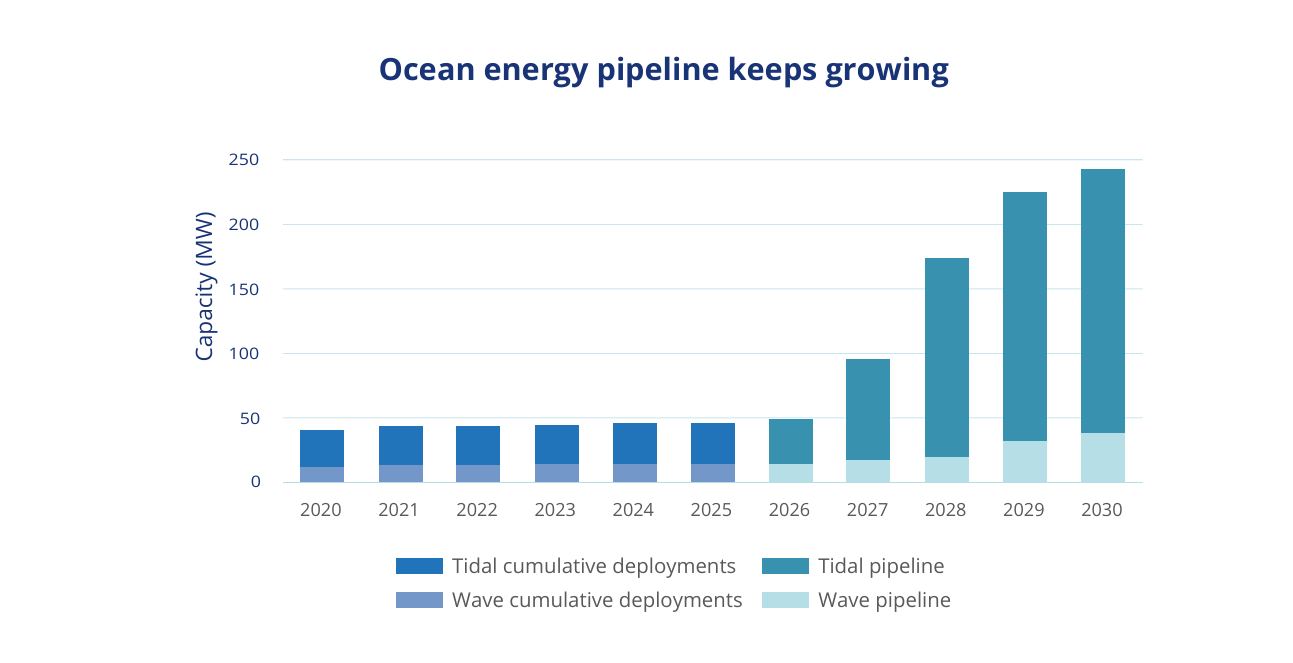
A new Ocean Energy Europe report shows 16 publicly funded farms are set to deploy 196 MW by 2030, with private investment following public support
Europe’s ocean energy sector is gearing up for industrialisation, with around 200 devices set to be deployed by 2030. The pipeline is driving serial manufacturing, strengthening European supply chains and attracting private investment, according to Ocean Energy Europe’s newly published Stats & Trends: Ocean Energy Market Outlook 2025.
Public grants and national revenue-support schemes have been instrumental in bringing these projects forward. With national targets and commitments mapping out a further 650 MW by 2030, Europe has an opportunity to turn its technological leadership into a new industrial sector.
From individual devices to serial manufacturing for both tidal and wave
Europe’s tidal pipeline now comprises 11 pre-commercial farms, representing 172 MW and 140 devices. Revenue support, particularly the UK’s Contracts for Difference (CfD) auctions and French feed-in tariffs, has been the main driver of this growth. France’s commitment to launch a commercial tender for 250 MW of tidal capacity by 2030 provides a further opportunity to expand the market.
Wave energy is also moving into farm-scale deployment. Five publicly funded farms, representing 24 MW and 66 devices, are due to be deployed by 2030. Among the major additions is CorPower Ocean’s 10 MW VianaWave project in Portugal, supported by a €40m Innovation Fund grant. The project is the largest wave farm allocated to date and will use a dedicated assembly facility in Portugal.
Public support unlocks private investment
The growing pipeline is already translating into manufacturing investment. In 2025, SKF committed a seven-figure investment to a dedicated tidal turbine assembly hall in Hamburg, with capacity to produce 25–30 drivetrains annually. Ocean energy developers are also working with local shipyards and suppliers, anchoring industrial activity and jobs in Europe.
The report records €150m of private investment in ocean energy over the past five years, with investment in 2025 remaining at the same level as in 2024. Venture capital funds, institutional investors and energy companies are increasingly backing the sector as publicly supported projects move forward.
European grants reduce the capital required for the first farms, while revenue-support mechanisms provide the predictable income needed to make projects bankable. Together, they help mobilise private finance and accelerate the sector’s industrial scale-up.
Rémi Gruet, CEO of Ocean Energy Europe, commented:
“Europe has spent years building a technological lead in ocean energy. We are now seeing that investment translate into real farms, manufacturing capacity and private finance. Industrial scale-up is taking shape, and the sector is ready to deliver.
“Public support has worked. It has brought projects forward and given investors the confidence to commit. Governments now need to build on that momentum with long-term revenue support and clear market targets. This is how Europe can turn its technological advantage into a competitive industry that delivers home-grown renewable power, jobs and energy security.”
Europe’s industrial opportunity in a growing global market
Europe remains the global leader in ocean energy technology and deployment, but international competition is increasing. The United States earmarked $141m for ocean energy in its 2025 budget, matching its 2024 allocation, while China has set a 400 MW ocean energy target for 2030. Continued European and national support will be necessary to retain this advantage and turn the existing pipeline and national commitments into deployed capacity.
The findings follow OEE’s Global Resource Assessment, published in June, which showed that ocean energy could supply 13% of global electricity demand and 21% of current EU consumption. Together, the two publications demonstrate the scale of the resource and the progress being made to harness it.
The sector’s next phase will be in focus at ICOE OEE 2026, taking place in The Hague from 5–7 October, where industry leaders, policymakers and researchers will discuss the projects, technologies and policies shaping ocean energy’s industrial rollout.
Read the full report: Stats & Trends: Ocean Energy Market Outlook 2025
Find out more about ICOE OEE 2026.